Home Office Mastery: Engineering the High-Output Solo Sanctuary
In the evolution of the modern professional landscape, the domestic environment has undergone a radical transformation. For the solo professional, the living room is no longer merely a space for passive recovery; it is the strategic headquarters of a sovereign empire. However, the attempt to merge a high-stakes "Output Zone" with a low-stakes "Rest Zone" within the same 500 square feet often results in a phenomenon known as Contextual Bleed. Without a rigorous technical framework, your home office can become a source of chronic cognitive load, eroding both your professional performance and your mental health.
This super-pillar article provides the definitive technical blueprint for high-output home office design for small spaces. We will move beyond superficial aesthetics to analyze the biomechanical engineering of posture, the physics of photon management, and the neuropsychology of Spatial Anchoring. Backed by standards from The Mayo Clinic↗ and The WELL Building Standard↗, this is your manual for building a sovereign headquarters.

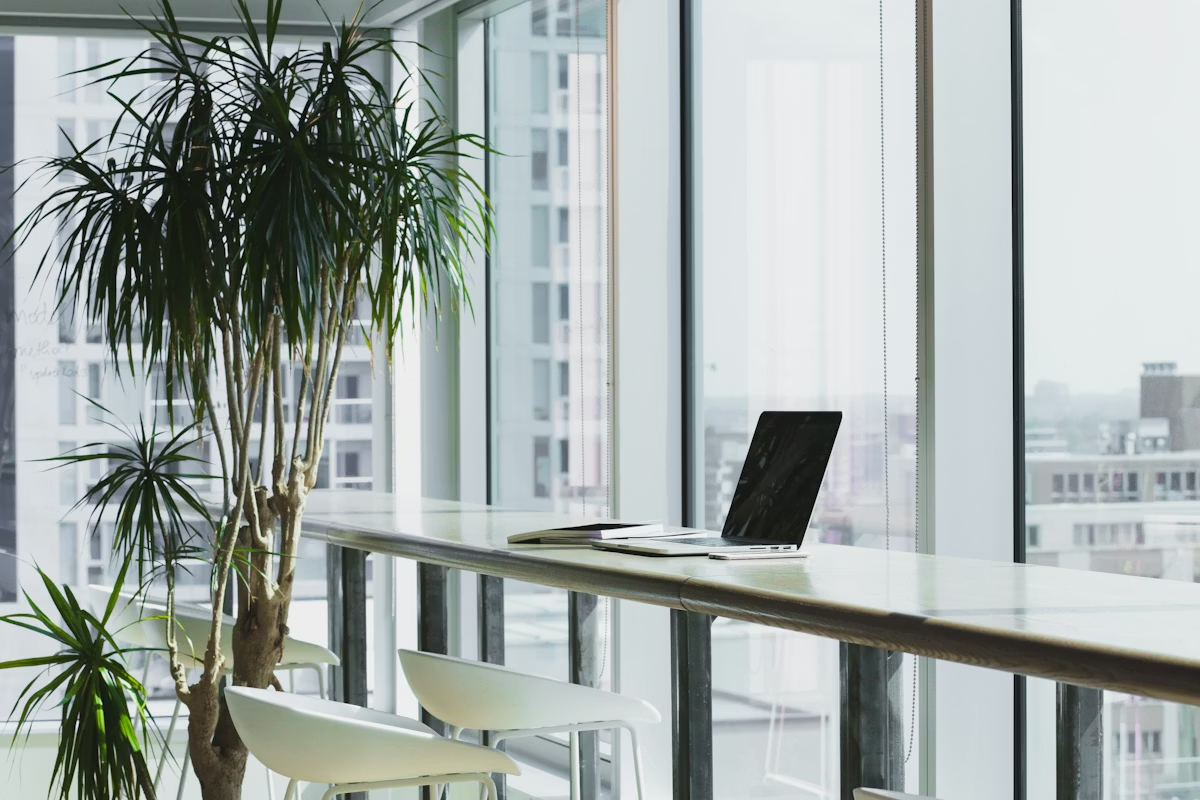
A high-end, professionally engineered home office lab designed for elite solo productivity
1. The Science of Spatial Anchoring: Deconstructing Contextual Bleed
The human brain is a highly advanced pattern-matching machine. It relies on environmental cues to determine which "Neural Operating System" to run. When you work from the same sofa where you consume entertainment, your brain suffers from Contextual Bleed. The neural pathways associated with high-cortisol deadlines begin to overlap with the pathways associated with relaxation. The result is a state of perpetual "Semi-Focus" and "Semi-Rest," where you are never fully productive and never fully recovered.
To achieve Home Office Mastery, you must negotiate a "Geographic Contract" with your brain. This is the science of Spatial Anchoring. Even in a micro-studio, your workspace must have a distinct sensory profile that separates it from the rest of your home.
The Sensory Boundary Protocol
- Tactile Anchoring: Use a specific low-pile rug to define the office perimeter. The moment your feet touch that texture, you signal to your Basal Ganglia that the "Professional Mode" is now active.
- Visual Sequestration: Utilize physical barriers—bookshelves, room dividers, or even the strategic placement of your desk facing away from the rest of the room—to limit your Peripheral Field of View (refer to our Digital Minimalism guide).
- Olfactory Triggering: Use a specific scent (e.g., Rosemary or Peppermint) exclusively during deep-work sessions. This leverages the Olfactory Bulb’s direct connection to the hippocampus to trigger immediate focus.
By enforcing these boundaries, you transform a corner of your living room into a sovereign territory, protecting the Science of Solitude from the domestic distractions of your daily life.

A minimalist desk setup using a tactical rug to create a spatial anchor and psychological boundary
2. Biomechanical Kinetics: The 90-90-90 Rule and Spinal Integrity
Your body is the hardware that runs the software of your cognitive output. Most "living room offices" are biomechanical disasters, leading to Musculoskeletal Entropy. According to ergonomic research from The Mayo Clinic↗, poor posture doesn't just cause back pain; it induces Cognitive Fatigue by forcing the brain to dedicate neural resources to muscle stabilization.
The 90-90-90 Geometry
To maximize output, your workspace must facilitate Kinetic Neutrality:
- Elbows at 90°: Your keyboard height must allow your forearms to be parallel to the floor.
- Hips at 90°: Your chair must support your natural Lumbar Lordosis while keeping your thighs horizontal.
- Knees at 90°: Your feet must be flat on a solid surface. If your chair is too high for your desk, use an ergonomic footrest to maintain this angle.
Oculomotor Alignment
The top third of your monitor must be at eye level. This prevents the "Cervical Flexion" (Tech Neck) that restricts blood flow to the brain. By maintaining a neutral spine, you improve your Proprioceptive Feedback Loop, allowing your brain to enter the Flow State faster and stay there longer.

A solo professional demonstrating perfect 90-90-90 ergonomics at a custom-engineered desk
3. Photon Management: Kelvin Shifts and Cortisol Regulation
Lighting is the most powerful Circadian Entrainment tool in your environment. In a dual-purpose living room, the lighting that makes a movie feel cozy is the same lighting that makes your brain feel lethargic during a work sprint. To master your output, you must control the Light Spectrum.
The Circadian Toggle
The WELL Building Standard↗ emphasizes "Melanopic Lux"—light that specifically targets the receptors in the eye that regulate sleep-wake cycles.
- The Output Phase (08:00 - 15:00): Use bulbs with a color temperature of 5000K to 6500K (Cool Daylight). This spectrum mimics high-noon sun, suppressing melatonin and spiking alertness.
- The Transition Phase (15:00 - 18:00): Shift to 4000K (Neutral White) to maintain focus without over-stimulating the nervous system.
- The Recovery Phase (18:00+): Switch to 2700K (Warm Amber). This signals the end of the "Work Hunt" and allows your cortisol baseline to drop.
By automating these shifts via smart lighting, you use your home architecture to manage your internal biology, a core tenet of the Mediterranean Mindset.
4. Acoustic Sequestration: Building a Wall of Silence
In an open-plan micro-apartment, visual boundaries are often porous. Therefore, your primary defense against distraction must be Acoustic Sequestration. Sounds from the street, the refrigerator, or neighbors create "Auditory Startle Responses" that fragment your deep work focus.
The Physics of Sound Masking
- Pink Noise Arbitrage: Unlike White Noise, Pink Noise has higher energy at lower frequencies, mimicking the sounds of rain or wind. It is scientifically proven to reduce brain wave complexity, inducing a state of calm focus.
- Textural Absorption: Use heavy curtains, high-density rugs, and acoustic panels to lower the Reverberation Time of your room. A "Live" room (lots of echo) increases the cognitive effort required to process information. A "Dead" room (acoustically dampened) allows for total cognitive immersion.
5. Biophilic Feedback Loops: Attentional Restoration Theory
The Attentional Restoration Theory (ART) suggests that "Direct Attention" (used for spreadsheets and coding) is a finite resource that leads to fatigue. Looking at nature, even briefly, allows this system to rest.
Mitochondrial Support
Integrating biophilic elements into your high-output home office design provides more than just aesthetic value:
- NASA-Approved Oxygenation: Plants like the Sansevieria (Snake Plant) or Epipremnum aureum (Pothos) are proven by NASA’s research↗ to remove indoor toxins while pumping fresh oxygen directly into your workspace.
- Fractal Patterns: The brain processes the complex, repeating patterns of leaves effortlessly. This reduces the "Neural Noise" of your environment and recharges your executive function battery.

Minimalist workspace flooded with natural light and biophilic elements to prevent cognitive fatigue
6. Atmospheric Engineering: The Invisible CO2 Barrier
In a small, 1-person apartment, CO2 levels can rise from 400ppm to over 1500ppm in just 2 hours of seated work. According to environmental health studies, CO2 levels above 1000ppm cause a 15% drop in cognitive scores and a significant increase in Decision Fatigue.
The Oxygenation Protocol
- Cross-Ventilation: You must open two windows for 5 minutes every 90 minutes of work. This "flushes" the apartment and resets the ionic balance of the air.
- Air Scrubbing: If your living room lacks multiple windows, use a medical-grade HEPA filter with an activated carbon layer to sequester Volatile Organic Compounds (VOCs) that interfere with respiratory efficiency.
7. The Peripheral Field Audit: Deleting Visual Noise
As discussed in our Digital Minimalism pillar, your brain is constantly processing everything in your Peripheral Field of View (FOV). If you can see a stack of dirty dishes or an unmade bed while trying to write a report, your brain is performing "Background Processing" on those tasks.
Visual Sequestration logic
- The 180-Degree Rule: Your workspace FOV should be 100% professional. If you cannot move the dishes, use a physical screen or a "Desk Shell" to block them.
- Cable Management: Visible cables are "Visual Friction." They signal disorder to the subconscious. Use high-tier cable management systems to hide the "Nervous System" of your office.
8. The Kinetic Office: Movement as a Focus Tool
A "Static Office" is a stagnant mind. To maintain the Mediterranean Longevity habits, your workspace must be kinetic.
Integrating NEAT
Non-Exercise Activity Thermogenesis (NEAT) is the energy we expend on everything that isn't sleeping or sports.
- Standing Desks: Use a sit-stand converter to shift your posture every 45 minutes. This prevents "Venous Pooling" and keeps the blood-oxygen levels in the brain high.
- Micro-Movements: Keep a mobility ball under your desk. Massaging your feet while working stimulates the nerve endings, keeping the brain's "Alertness Center" (the Locus Coeruleus) active without distracting from the task.
9. Logistical Minimalism: The Disappearing Office
The final challenge of the living room office is preserving the Integrity of the Sanctuary. Your home must not look like a corporate cubicle at 9:00 PM.
The Recovery Phase Architecture
- The Laptop Drawer: When the workday ends, the tech must disappear. If you can see your laptop, you are still "at work."
- Modular Tech: Use a wireless mechanical keyboard and mouse that can be stored in a drawer in 10 seconds.
- Sanctuary Integrity: By "hiding the lab," you allow your brain to fully transition into the Rest Phase, ensuring you wake up the next morning with zero residual stress.
10. The Sovereign Headquarters: The Future of Solo Performance
Mastering your home office is the ultimate act of self-governance. You are the architect, the engineer, and the elite operator of your own life. By applying the principles of Spatial Anchoring, Biomechanical Kinetics, and Atmospheric Engineering, you have turned your living room into the most powerful productivity tool on the planet.
The office is a legacy of the industrial age. The Solo Sanctuary is the headquarters of the future. Build the space. Reclaim your output. Live sovereign.
The Spiderweb: Internal Connections
- *Learn how to manage your square footage in Micro-Apartment Magic.*
- *Discover the neural mechanics of deep work in The Science of Solitude.*
- *Protect your cognitive bandwidth via Digital Minimalism.*
Technical standards for this manual are derived from The Mayo Clinic↗ and The WELL Building Standard↗.