Digital Minimalism: The Architecture of Neural Sovereignty
In the complex orchestration of solo living—where your physical environment must simultaneously serve as a corporate headquarters, a recovery sanctuary, and a laboratory for personal growth—digital minimalism has transitioned from a niche philosophy to a biological imperative.
For the solo professional, the smartphone is not merely a tool; it is a "Digital Roommate" that never sleeps, never stays silent, and constantly competes for your most valuable asset: your Cognitive Capital. Unlike those in multi-person households, the solo dweller lacks the natural "Social Mirroring" that often interrupts a dopamine-fueled scroll. Without a partner to ask, "Why are you still on your phone?", the individual is at the mercy of algorithms engineered by thousands of engineers to bypass human willpower.
This super-pillar article dissects the urgent necessity of the Phone-Free Zone (PFZ). We will explore the neuroscience of the Prefrontal Cortex, the devastating economics of Attention Residue, and the architectural strategies to reclaim 15+ hours a week for high-tier Skill Compounding. Backed by the research of Cal Newport↗, The Center for Humane Technology↗, and Harvard’s Research on Digital Wellness↗, this is your blueprint for neural sovereignty.

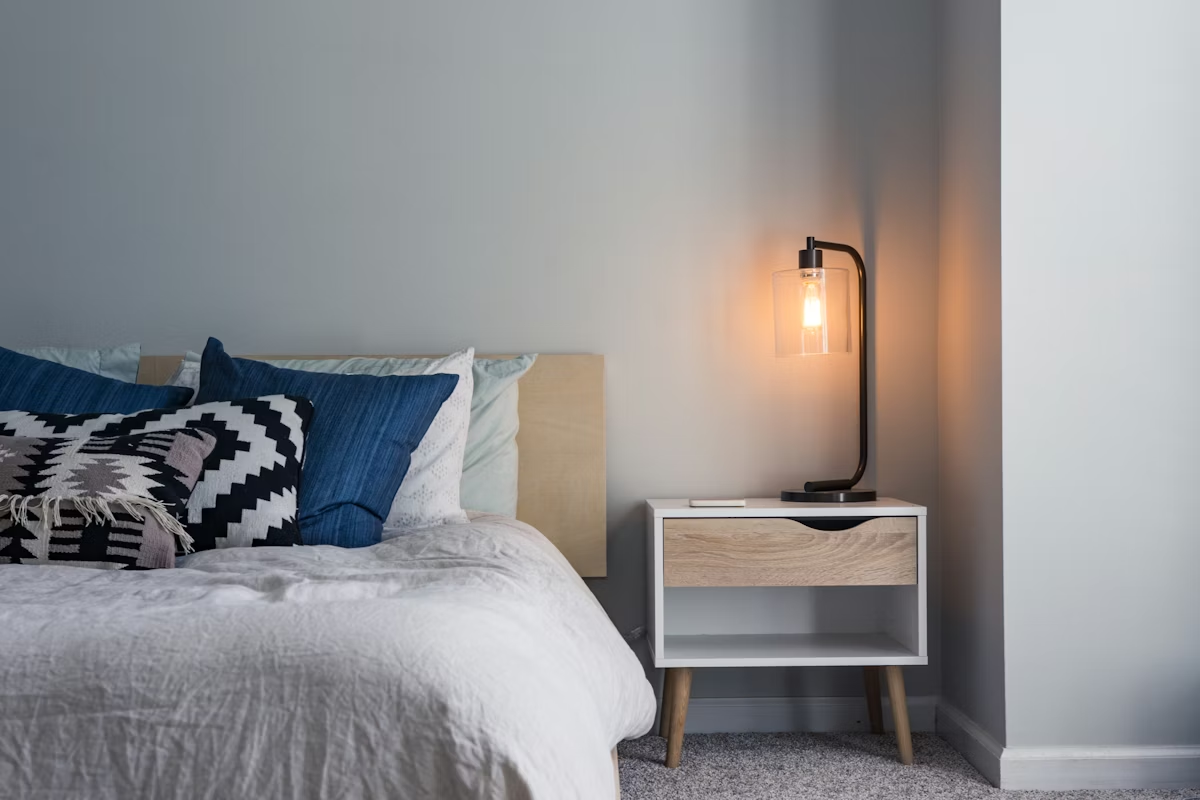
A serene minimalist living space with natural light and clean lines, evoking calm focus
1. The Neuroscience of Distraction: The Prefrontal Cortex Under Siege
To understand the necessity of a PFZ, one must first understand the biological mismatch between the 300,000-year-old human brain and the 15-year-old smartphone. At the center of this conflict is the Prefrontal Cortex (PFC)—the brain's executive command center responsible for focus, impulse control, and complex decision-making.
The Dopamine Hijack
The smartphone operates on a Variable Reward Schedule, the same psychological mechanism that makes slot machines addictive. Every notification triggers the Ventral Tegmental Area (VTA) to release a surge of dopamine. In a solo living environment, the "Quiet of the House" creates a sensory vacuum that your brain is desperate to fill. The phone becomes the path of least resistance.
Research from Harvard’s Digital Wellness Lab↗ demonstrates that chronic smartphone "multi-tasking" actually leads to Cortical Thinning in the PFC. You aren't just distracted; you are physically degrading your capacity for The Science of Solitude. When your PFC is weak, you lose the ability to enter the Default Mode Network (DMN)— the neural state where your greatest creative breakthroughs occur.
The Biological Cost of the "Ping"
Even if you don't pick up the phone, the mere presence of a smartphone within your line of sight reduces your Fluid Intelligence and Working Memory Capacity. This is known as "Brain Drain." For the solo professional working from a home office, having a phone on the desk is like running a high-performance engine with a leak in the fuel line.
A PFZ isn't just about "putting the phone away"; it is about creating a physical perimeter where your VTA is not being constantly stimulated. This allows your baseline dopamine levels to reset, a process Dr. Anna Lembke calls Dopamine Homeostasis. Without this reset, your solo life will feel like a constant state of "Low-Level Anxiety," preventing you from ever truly feeling the benefits of your independent lifestyle.
2. Attention Residue: The Solo Professional’s Silent Profit Killer
When you live alone, your home is your economic engine. However, the blending of "Rest Zones" and "Work Zones" creates a phenomenon known as Contextual Bleed. This bleed is accelerated by the smartphone, leading to a devastating state called Attention Residue.
The 20-Minute Cognitive Penalty
Coined by Sophie Leroy, Attention Residue occurs when you switch from one task (like writing a report) to another (like checking a "quick" WhatsApp notification). Even after you put the phone down, a portion of your neural resources remains stuck on that notification.
- The Math of Inefficiency: If you check your phone every 15 minutes, you are never operating at 100% cognitive capacity. You are permanently stuck in a state of Semi-Distraction.
- The Solo Multiplier: In a shared office, social cues often stop you from checking your phone. In a solo home office, there is zero friction. This makes the solo professional 50% more susceptible to Attention Residue than a corporate worker.
Reclaiming the Deep Work State
To build a successful solo career, you must master Deep Work—the ability to focus on a cognitively demanding task without distraction. As noted in Cal Newport’s Deep Work methodology↗, this state is impossible to achieve in an environment where a smartphone is present.
By establishing a PFZ in your home office, you apply a Kinetic Barrier to distraction. You force your brain to move past the "Boredom Threshold" where real innovation happens. When you eliminate Attention Residue, you aren't just "working faster"—you are working deeper. You begin to produce the kind of high-value output that funds a luxury solo lifestyle.
3. The Spatial Architecture of the Phone-Free Zone
A Phone-Free Zone is not a "suggestion"; it is a spatially enforced rule. In a small apartment or micro-studio, you must use Environmental Priming to tell your brain which "Version of You" is currently in control.
The "Digital Landing Strip" Strategy
The first step in PFZ architecture is the Digital Landing Strip. This is a dedicated charging station located near your front door. The rule is simple: when you cross the threshold of your sanctuary, the phone is "Docked." It is no longer a mobile device; it becomes a stationary "Landline" that you only check during scheduled intervals.
The Three Sacred Zones
- The Bedroom (The Zero-Blue Zone): The bedroom must be an absolute PFZ. Using your phone as an alarm clock is the ultimate strategic error. It ensures your day starts with a Reactive Mindset instead of the Solo Morning Ritual. Buy an analog clock and reclaim your sleep hygiene.
- The Dining Table (The Sensory Zone): Eating alone is a form of meditation. When you scroll while you eat, you engage in Mindless Consumption, which destroys your digestive efficiency and your relationship with food. (Refer to our 15-Minute Solo Pasta guide for mindful eating).
- The Deep Work Corner: Your desk must be a "Sanctuary of Output." If the phone enters this zone, the work session ends. This is Spatial Anchoring—conditioning your brain to realize that in this specific 4x4 foot area, the digital world does not exist.

A clean bedroom sanctuary with an analog clock and no technology, promoting deep rest
4. Time Arbitrage: Reclaiming the 15-Hour Dividend
Most solo dwellers complain about a "Lack of Time." In reality, they have an Attention Leak. The average adult spends 4.5 hours a day on their smartphone. For the solo professional, this is often higher. By implementing a PFZ, you engage in Time Arbitrage—buying back your own life from the Attention Economy.
The Power of the "Skill Hour"
If you reclaim just 2 hours a day from mindless scrolling, you gain 730 hours a year. This is the equivalent of 18 full work weeks. What could you achieve with an extra 18 weeks of focused time?
- Master a new language.
- Build a secondary passive income stream.
- Master Batch Cooking 2.0.
- Optimize your Social Fitness.
The Compounding Effect of Focus
Time spent in a PFZ is "Higher Quality Time." One hour of undistracted "Deep Time" is worth four hours of distracted "Shallow Time." By enforcing digital minimalism, you are effectively "Aging your Skills" faster than the competition. You are out-pacing the distracted masses while they are still arguing in comment sections. This is the ultimate competitive advantage of the sovereign solo resident.
5. Solitude vs. Digital Loneliness: The Psychological Shift
There is a profound difference between Solitude (the joy of being alone) and Digital Loneliness (the pain of being connected but unseen). The smartphone is the primary driver of digital loneliness. It provides a "Pseudo-Social" hit that tricks the brain into thinking it has interacted with a human, without the oxytocin or the emotional depth of real connection.
The Mirroring Crisis
When you live solo and spend 6 hours on your phone, you are effectively "Ghosting" yourself. You are ignoring your own physical environment and your own internal thoughts. This leads to Existential Drift—the feeling that your life is happening elsewhere, inside the screen.
Reclaiming the Interior Life
A PFZ forces you to confront the "Silence of the House." While this can be uncomfortable for the first 72 hours (Digital Withdrawal), it eventually leads to the development of a Rich Interior Life. You start to notice the quality of the light in your apartment. You start to hear your own creative voice.
As The Center for Humane Technology↗ points out, our technology is designed to "downgrade" our humanity. By stepping into a PFZ, you are Upgrading your consciousness. You are transitioning from a consumer of other people’s lives to the architect of your own.

A minimalist dining ritual with a book and coffee, showing a life lived intentionally
6. The Kinetic Barrier: Engineering Willpower Out of the Equation
Willpower is a finite resource. If you have to "decide" not to check your phone every 5 minutes, you will eventually fail due to Decision Fatigue (refer to our Decision Fatigue masterclass). The secret to digital minimalism is not "trying harder"; it is Friction Engineering.
The Rule of Proximity
The ease of a habit is determined by the distance to the trigger. If your phone is in your pocket, the "Friction to Fail" is zero. If the phone is in a timed kitchen safe or a separate room, the "Friction to Fail" is high.
- The Faraday Hack: Use a signal-blocking pouch or a drawer in a different room as your "Digital Purgatory."
- The Analog Proxy: Replace phone functions with single-purpose analog tools. A physical notebook for ideas, a paper map for travel, and a high-end camera for photography. By "Unbundling" the phone, you reduce its status from a "God-Object" to just another piece of hardware.

A lone person reading a book in a sunlit room, representing the ultimate peace of a phone-free life
Final Thoughts: The Sovereign Life is a Curated One
Digital minimalism is the ultimate act of rebellion in the 21st century. For the solo resident, it is the difference between a life of Distracted Consumption and a life of Sovereign Creation.
Start today. Pick one room. Declare it a Phone-Free Zone. Reclaim your breath. Reclaim your attention. Reclaim your life.
Your sanctuary is waiting. Don't let the algorithm in.
The Spiderweb: Internal Connections
- *Learn how to use your reclaimed focus for The Science of Solitude.*
- Strengthen your real-world connections with our Social Fitness manual.