The 15-Minute Solo Pasta: The Technical Manual for One-Pan Fluidics and Zero-Cleanup Nutrition
In the architectural orchestration of a high-performance solo life, the kitchen is often the site of the greatest logistical failure. For the independent professional, the transition from a state of intense cognitive output—facilitated by the Science of Solitude—to the necessity of biological refueling represents a critical friction point. Traditionally, the "gourmet" experience has been tethered to a high-overhead model: multiple pots, complex timing, and an exhaustive cleanup phase that deters the soloist from pursuing nutritional excellence.
This manual deconstructs the traditional pasta-cooking paradigm and introduces One-Pan Fluidics. By treating the cooking vessel as a closed-loop thermodynamic system, we can achieve Michelin-level results in under 900 seconds. We will analyze the molecular biology of starch gelatinization, the physics of lipid conductivity, and the logistical protocols required to maintain a Zero-Cleanup environment. This is not a recipe; it is a technical intervention for the sovereign table.

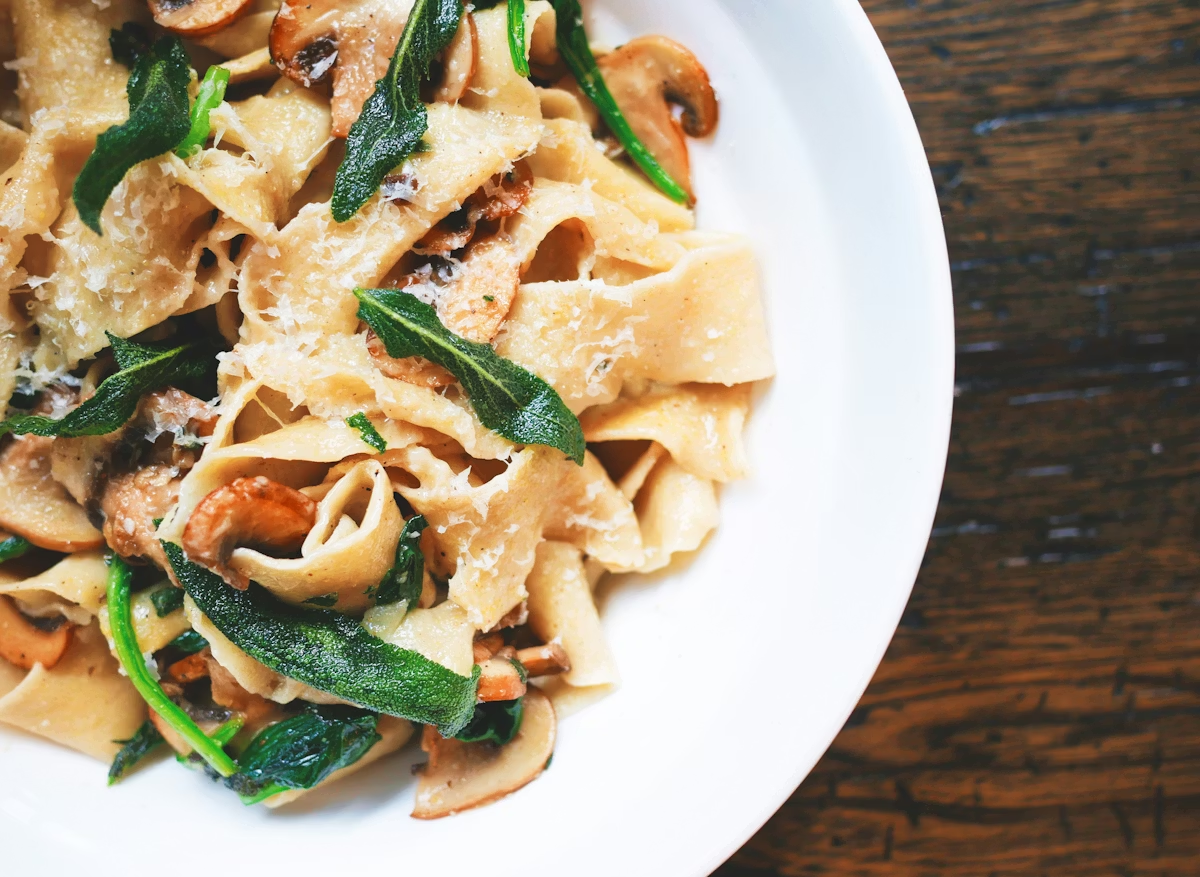
A high-end gourmet pasta dish representing the intersection of culinary engineering and solo efficiency
1. The 15-Minute Window: The Bio-Psychological War Against the Delivery App
The "15-Minute Window" is a physiological threshold identified in nutritional psychology as the period between the cessation of work and the onset of "Decision Collapse." For the solo professional, this window is a dangerous time. As glucose levels in the prefrontal cortex dip following a deep-work session, the brain’s executive function becomes compromised by Decision Fatigue. In this state, the friction of boiling a massive pot of water and chopping complex ingredients feels insurmountable.
This cognitive decline is exactly what delivery-app algorithms are designed to exploit. They offer a low-friction, high-cost, and usually low-nutrient alternative that arrives exactly when your willpower is at its nadir. To defeat the delivery-app surge, your home-based nutritional system must have a "Start-to-Plating" time of 15 minutes or less.
By engineering a meal that requires only a single pan and three core ingredients, you reduce the "Activation Energy" required to cook. We are essentially automating the "Maintenance Layer" of your life. When the 15-minute solo pasta becomes a protocol rather than a choice, you protect your cognitive capital and ensure that your Lunch-Hour HIIT is followed by high-quality glycogen restoration rather than a processed sugar crash.
2. One-Pan Fluidics: Thermodynamics of Aqueous Absorption
Traditional culinary school teaching dictates that pasta must be cooked in a large volume of heavily salted water. This "Excess Water Model" is designed to dilute the starch released from the pasta to prevent sticking. However, for the solo chef, this creates two inefficiencies: long thermal ramp-up times (waiting for the water to boil) and the loss of the most valuable chemical byproduct of the process—the starch itself.
One-Pan Fluidics utilizes a "Measured Absorption Model." By placing dry pasta in a wide skillet with a precisely calculated amount of cold water (typically 1.5 to 2 times the weight of the pasta), we alter the thermal dynamics of the dish.
The Heat-Transfer Curve
In a wide skillet, the surface-area-to-volume ratio is maximized. This facilitates rapid evaporation while simultaneously concentrating the heat into the pasta strands. As the water boils, it doesn't just hydrate the pasta; it creates a churning, high-velocity starch bath. Because the pasta starts in cold water, the starch granules on the surface begin to swell and burst earlier in the process. This creates a viscous "Starch Slurry" that will eventually form the base of our sauce. This is the Thermodynamic Dividend: the energy used to boil the water is the same energy used to emulsify the sauce.
3. The Molecular Biology of Starch: "Liquid Gold" as a Chemical Bridge
To understand why one-pan pasta tastes "creamier" without the addition of cream, we must look at the behavior of amylose and amylopectin. As the pasta reaches its Gelatinization Temperature (approximately 140°F to 160°F), the starch molecules leach into the surrounding liquid.
Spontaneous Emulsification
In the traditional method, this starch is poured down the drain. In the 15-minute manual, we treat this liquid as Liquid Gold. Starch molecules are amphiphilic in nature—meaning they can interact with both water (the aqueous phase) and oil (the lipid phase).
When you add a high-tier Extra Virgin Olive Oil (refer to our Mediterranean Mindset guide) to the pan during the final three minutes of cooking, the concentrated starch acts as a Molecular Bridge. It binds the fat to the water, creating a stable, glossy emulsion that clings to the pasta. This is a superior chemical process to adding fat at the end of a traditional boil, where the oil often just slides off the wet, non-starchy surface of the noodle.

Raw ingredients: high-quality bronze-die pasta, garlic, and lemons representing the components of flavor stacking
4. The Law of Three: Engineering Ingredient Selection
Complexity is the enemy of the solo resident. To achieve 5-star flavor without 5-star effort, we apply The Law of Three. This engineering theory states that any masterpiece dish can be reduced to three high-yield variables: The Fat, The Acid, and The Aromatic.
The Formula:
- The Fat (Conductor): High-polyphenol EVOO or Grass-fed Butter. Fat carries the flavor and provides the satiety signal to the brain.
- The Acid (Highlighter): Fresh Lemon Juice, Aged Balsamic, or Dry White Wine. Acid cuts through the starch and fat, waking up the palate and preventing "Sensory Monotony."
- The Aromatic (Depth): Slivered Garlic, Crushed Peperoncino, or Fresh Anchovy. These provide the volatile organic compounds (VOCs) that create the olfactory experience of the meal.
By limiting yourself to these three categories, you eliminate the cognitive load of "Recipe Searching." You simply pick one from each category based on what you have in your Inventory Arbitrage stock.
5. Maillard Kinetics at the Solo Table: Browning in a Single Vessel
A common critique of one-pan meals is the lack of "seared" depth. We solve this by manipulating the timing of the Maillard Reaction—the chemical reaction between amino acids and reducing sugars that gives browned food its distinctive flavor.
The Two-Stage Thermal Protocol
In our 15-minute method, we don't start by boiling. We start by Infusing.
- Stage 1 (Dry-ish Heat): Place your aromatics (garlic/chili) in the pan with the fat over medium-low heat before adding the water. This allows the fat to extract the fat-soluble flavor compounds.
- Stage 2 (The Steam Phase): Once the garlic is golden (Maillard complete), add the pasta and cold water.
This ensures that while the pasta is hydrating in the steam, it is doing so in a liquid already saturated with browned, complex flavors. The result is a depth of flavor that usually takes hours of slow-simmering, achieved in the time it takes to check your email.

The process of high-heat conduction in a single skillet, capturing the fluidic transfer of flavor
6. Hardware Audit: The Technical Case for the Wide Skillet
In a micro-apartment, vertical space is for storage, but horizontal space is for performance. The traditional deep stockpot is an inefficient tool for the solo professional.
The Skillet Advantage
- Evaporation Control: A 12-inch stainless steel skillet provides a massive surface area. This allows you to control the thickness of your starch-sauce with minute-by-minute precision.
- Thermal Response: Skillets have less thermal mass than a 5-quart pot, meaning they respond to temperature changes instantly. This is vital when you reach the "Emulsification Point" and need to kill the heat to prevent the sauce from breaking.
- Visual Feedback: You can see every strand of pasta. You can monitor the "Bubble Size" of the water—large, clear bubbles mean mostly water; small, viscous, slow-popping bubbles mean the starch concentration is perfect.
Investing in one high-quality tri-ply stainless steel skillet is the most important step in Home Office Mastery; it turns your kitchen into a functional extension of your productivity lab.
7. Nutrient Density Engineering: The Post-HIIT Recovery Window
Your 15-minute pasta is not just a meal; it is a Metabolic Intervention. If you have just completed your Lunch-Hour HIIT, your muscles are in a state of glycogen depletion and your GLUT4 transporters are upregulated.
The Glycemic Load Hack
To prevent a post-pasta energy crash, we use Bronze-Die Pasta. Pasta extruded through bronze dies has a rough, porous surface. Not only does this hold the sauce better (physics!), but it also has a lower Glycemic Index (GI) than smooth, Teflon-extruded pasta because the starch is more "tangled" at the molecular level, taking longer for your enzymes to break down.
Add a handful of frozen peas or arugula at the very end. The residual heat will wilt them without destroying their heat-sensitive vitamins (Vitamin C and Folate). This adds fiber and micronutrients without increasing the cleanup load, keeping your Mediterranean Mindset intact.
8. Inventory Arbitrage: Sourcing High-Yield Components
The success of the solo kitchen depends on Inventory Arbitrage—stocking items that have a long shelf-life but provide an "Elite" flavor yield.
The Solo Staple List:
- Parmigiano Reggiano: Not "parmesan" in a shaker. Real Parmigiano lasts for months and provides instant Umami (glutamate) depth.
- Anchovy Paste: The secret weapon of the solo chef. A 1-inch squeeze into the fat provides a savory backbone that guests (and you) won't be able to identify but will certainly feel.
- Calabrian Chilies: High-heat, store-stable aromatics.
By having these high-yield assets in your Freezer Staples and pantry, you eliminate the need for mid-week grocery runs, further protecting your cognitive bandwidth.
9. The Sovereign Table: Neuropsychology of Mindful Consumption
The final stage of the 15-minute protocol is the Consumption Ritual. When you live solo, there is a biological temptation to eat directly from the pan over the sink. This is a catastrophic failure of Self-Governance.
Parasympathetic Activation
Digestion is a "Rest and Digest" process. If you eat while standing or while scrolling through your phone (refer to Digital Minimalism), your body remains in a sympathetic (stress) state. This inhibits enzyme production and leads to poor nutrient absorption and bloating.
The Protocol:
- The Plate: Use your heaviest, most beautiful ceramic plate.
- The Silence: No screens. For 10 minutes, your only focus is the Organoleptic Profile of the pasta.
- The Somatic Check: Notice the texture and the heat.
By treating yourself as an honored guest at your own table, you reinforce your self-worth and trigger the parasympathetic nervous system, ensuring you return to your Home Office Mastery session with absolute clarity.

The final result: a perfectly emulsified, high-nutrient solo meal that required only one pan and 15 minutes
10. Zero-Cleanup Systems: Logistical Post-Meal Restoration
The "Zero-Cleanup" claim is not a marketing myth; it is a result of Workflow Engineering.
The "Clean as You Hydrate" Protocol
- While the pasta water is heating (the first 4 minutes), you wash the knife and cutting board you used for the garlic.
- While the pasta is simmering (the next 9 minutes), you put the oil, pasta box, and aromatics back into their Inventory Arbitrage locations.
- The Final Wipe: Because the starch and oil have emulsified into a sauce, they don't stick to the stainless steel skillet. Once you finish eating, the pan only requires a 30-second rinse with hot water and a light scrub.
By the time you have finished your glass of water after the meal, the kitchen is already in a state of Full Restoration. You have bypassed the "Dread of the Dishes," allowing you to move directly into your afternoon deep-work or recovery phase with zero mental residue.
Final Thoughts: Culinary Sovereignty is a Skill
The 15-minute solo pasta is more than a recipe; it is a proof of concept. It proves that you can live a life of high efficiency without sacrificing the sensory luxury of the Mediterranean. You do not need a staff, you do not need an hour, and you do not need a delivery app. You only need the pan, the starch, and the discipline to honor your own table.
Master the fluidics. Own the 15 minutes. Live sovereign.
The Spiderweb: Internal Connections
- Fuel your afternoon output following a Lunch-Hour HIIT session.
- *Integrate your kitchen workflow into your Home Office Mastery.*
- *Reclaim your cognitive bandwidth by automating your meals via Decision Fatigue Mastery.*
Scientific and culinary data for this manual are derived from Serious Eats↗, Harvard T.H. Chan School of Public Health↗, and the molecular studies found in Nature Food↗.